In this article
A calendar change has edges
An extra block of work changes more than the middle of a day. It can move the time you leave home, the way you return, the moment you prepare a meal and the availability you already promised someone else. A whole-day reading makes those edges visible. It is a personal planning method, not a recommendation to accept or decline an actual assignment.
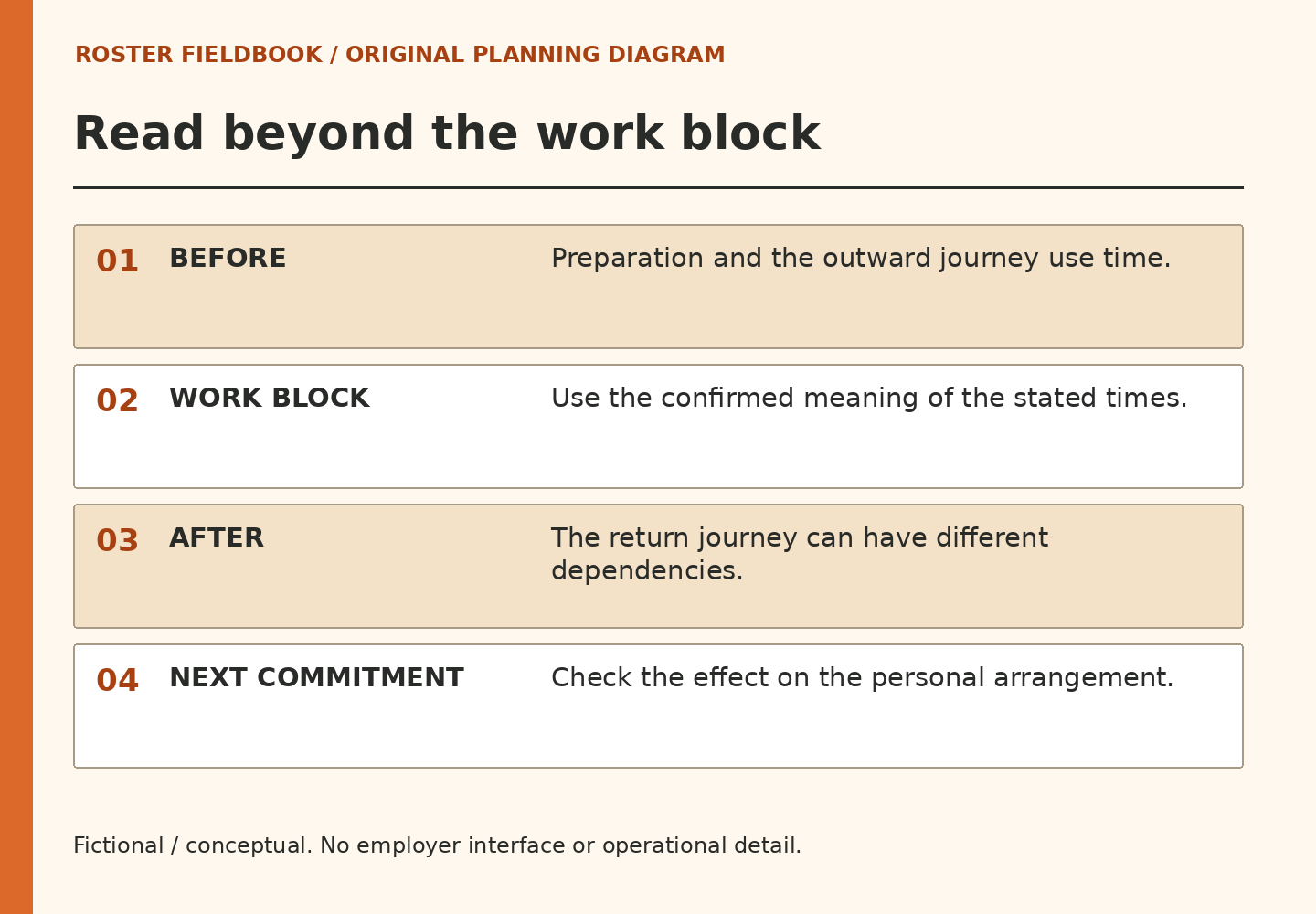
Start with an invented day rather than an employer roster. Put one proposed work block in the center of a blank page. Before and after it, add only the commitments necessary to understand the example. The purpose is to expose dependencies. A crowded page may indicate a conflict; a sparse page may simply indicate information you have not added yet.
Count connected commitments
Suppose a fictional six-hour block requires a forty-minute journey each way and twenty minutes of preparation. Those surrounding tasks add one hundred minutes to the occupied period. If the return trip depends on a service that becomes infrequent later, the likely arrival time needs a separate check. Equal work durations can have different effects on the rest of a day.
Keep estimates and verified facts visibly different. A convenient planning convention is to write estimates with a question mark and confirmed details without one. This convention is yours, not an employer status label. If a time changes, update the whole dependent chain rather than changing only the work block and leaving the old journey in place.
Ask what must move
The next question is not automatically “Can everything be squeezed in?” Ask which commitments would have to change. A shared errand may require another person’s agreement. A reservation may have a cutoff. A recurring responsibility may need preparation before the day begins. These are different kinds of constraints and should not be treated as interchangeable spare minutes.
In the invented example, a friend has agreed to share transport after an evening activity. Moving the activity without checking the friend creates a second unresolved arrangement. The calendar can represent that dependency with a pending marker. It should not silently turn someone else’s possible help into a confirmed resource.
Compare the version before and after
Write a short before-and-after summary: departure, occupied interval, return and one affected commitment. This makes the change easier to inspect than a page of small edits. Do not include a real work location or another employee’s information in a public exercise. A generic label such as “work block” is enough to learn the method.
The Offer Fit Sketch on the home page compares fictional time budgets. Its result is arithmetic, not evidence of approval, fitness for work, legal compliance or availability. Real decisions need information the model does not know. A positive remainder is room in the invented calculation, not an instruction to fill it. A negative remainder is a prompt to examine the conflict rather than erase a boundary. Recheck the authoritative work record before sharing a changed personal plan.
Evidence and boundaries
This article is an original planning exercise using invented examples. It does not report private employer procedures or an individual employee’s experience.
Roster Fieldbook is independent of Allied Universal. Actual assignments, approvals and requirements must be confirmed through verified official channels. No extra hours, pay or other outcome is guaranteed.
Continue with Compare Two Offers Without Hiding the Travel or try the Offer Fit Sketch.