In this article
One color can conceal four meanings
A block on a calendar looks definite even when the information behind it is not. It might be a possibility, a request, a confirmed commitment or an old entry that should no longer guide the day. Giving these states different labels prevents a personal planning aid from quietly becoming a source of false certainty.
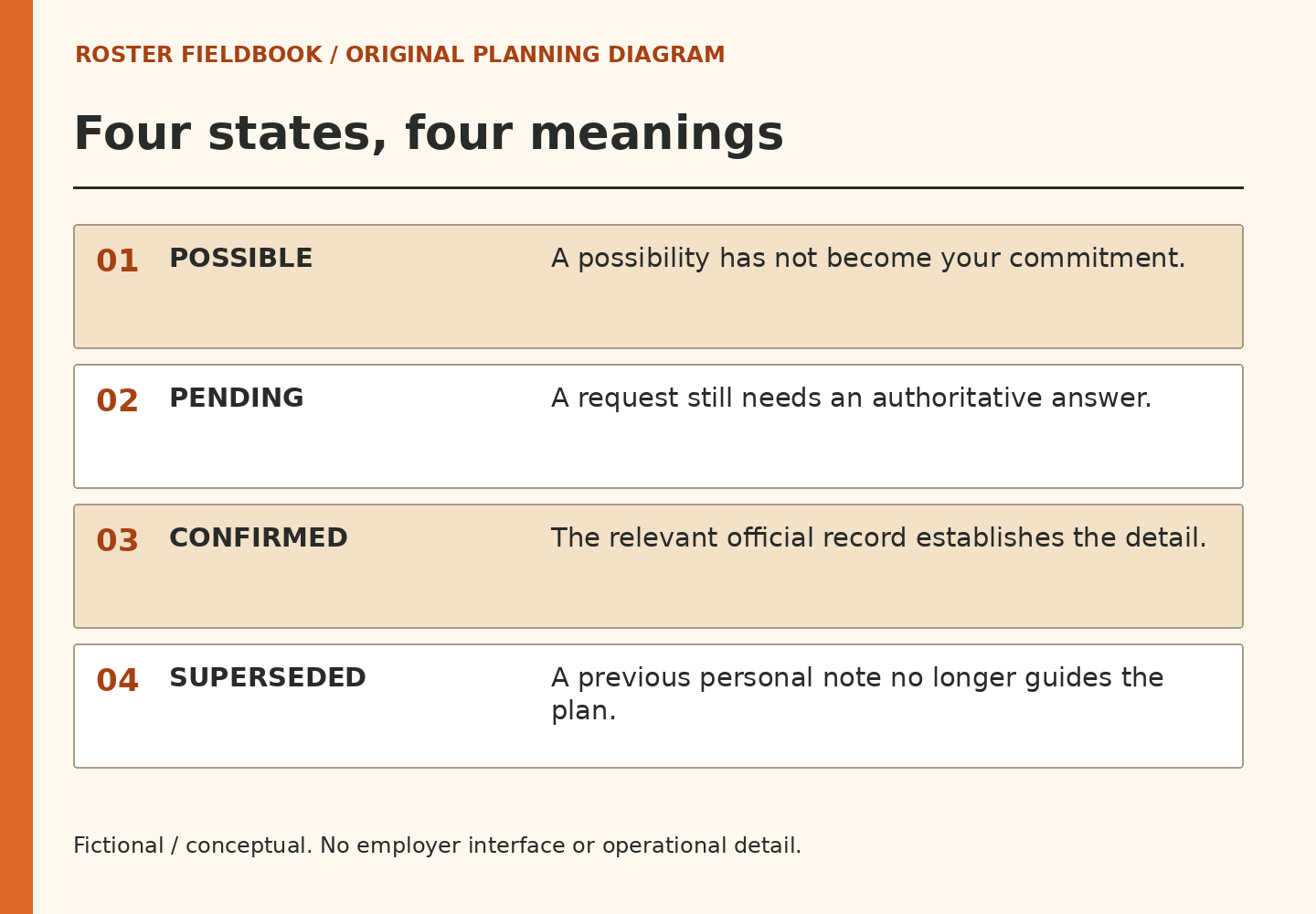
Use plain words rather than a complex code. “Possible,” “pending,” “confirmed” and “superseded” are enough for an invented exercise. These are personal notebook labels, not claims about the wording used by LISA or another employer system. The official record controls actual assignments. Your notebook helps you remember what needs checking.
Define what moves an entry
A possibility becomes a request when the actual request has been made through the appropriate process. A request becomes confirmed only when the relevant authoritative evidence supports that conclusion. A confirmed entry may later be replaced by updated information. Do not invent automatic transitions simply because time has passed or a message has been read.
Consider a fictional Saturday plan. An opportunity is mentioned on Monday, a question is submitted on Tuesday and the details are clarified on Wednesday. The notebook can preserve this sequence without storing the original workplace messages. Each step has a date, a short status and the next question. The progression is useful even if the final answer is that the opportunity will not proceed.
Resolve duplicate entries deliberately
An updated personal entry and its predecessor should not both appear current. Once the new information has been verified, mark the old personal note as replaced or remove its reminder. Retain whatever records the actual workplace process requires in the appropriate system. This article concerns your planning copy, not deleting official records.
If two sources disagree, do not choose the more convenient version. State the disagreement in neutral terms and use the verified channel to resolve it. A useful question identifies the affected date and the conflicting detail. It does not need to attach a whole roster or circulate other people’s names. The aim is to determine which instruction currently applies.
Review status before sharing time
Before making a household promise, inspect whether the time you plan to share is based on a confirmed commitment or a possibility. Someone coordinating a ride may need to know that a timing is still tentative. Sharing uncertainty accurately is more useful than sending a precise time that has not been established.
For practice, create four invented entries and explain what evidence would move each one. If you cannot name that evidence, leave the entry unresolved and formulate the question. A status ledger is not valuable because it contains many details. It is valuable because the details have clear meanings. The simplest version may be one line per unresolved issue, reviewed at an appropriate time rather than watched continuously. Close the loop by updating the people whose plans actually depended on the change.
Evidence and boundaries
This article is an original planning exercise using invented examples. It does not report private employer procedures or an individual employee’s experience.
Roster Fieldbook is independent of Allied Universal. Actual assignments, approvals and requirements must be confirmed through verified official channels. No extra hours, pay or other outcome is guaranteed.
Continue with Plan Both Ends of the Journey or try the Offer Fit Sketch.